
October 2026 Insights
Aspirations Wealth constantly monitors the investment markets and aims to keep our valued clients regularly informed and updated. We aim to help investors cut through all the media noise and hype and understand what is really driving investment markets and portfolio returns.
In this edition we cover:
Who gets your super when you die?
Did you know that your super isn’t automatically part of your estate when you die?
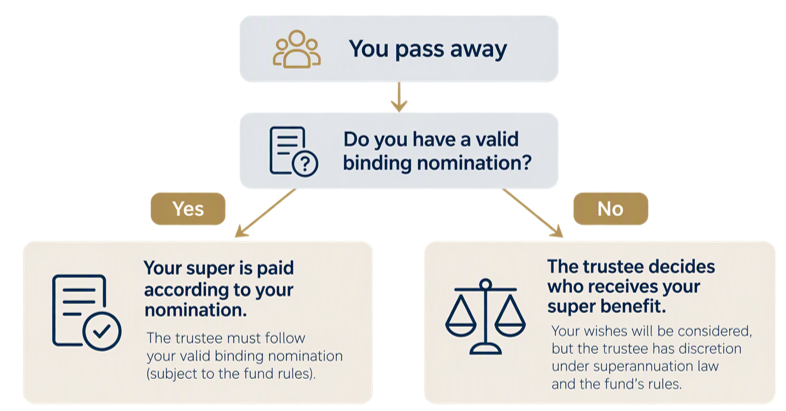
It can come as a surprise to many Australians who have done the work on creating a legal will to document their last wishes that the rules work differently with your superannuation. It’s not just that you need to nominate your chosen beneficiaries with your super fund, there are also strict rules around who you can nominate.
In fact, if you haven’t notified your super fund about your beneficiaries, or if you use a non-binding nomination, there are rules around how they identify and select your beneficiaries. It might not match your wishes.
Who can you leave your super to?
When you write a will, you can leave your money to anyone you want to. Your family, friends, neighbours, charities. Your choice!
When it comes to superannuation, there are laws around who can inherit your super (be a beneficiary) and then separate tax laws about how the money is paid and taxed.
Your super can go to:
Your current spouse or partner
Your children (of any age)
Someone in an interdependency relationship with you when you die (this is where you have a close personal relationship, live together, provide each other with domestic support and personal care and one or both of you provide financial support)
Anyone who is financially dependent on you when you die
Your legal personal representative (your estate – this means that the super is paid as a lump sum to the estate and is then distributed according to your legal will).
These are considered dependants from a superannuation perspective and therefore eligible beneficiaries.
How super death benefits are taxed
Tax law defines dependants differently, which has tax implications. Your dependants under current tax laws are:
Your spouse or current partner
A former or de facto spouse
Your child aged under 18 years
In an interdependency relationship with you
Anyone else financially dependent on you
An adult child may also be a dependant for tax purposes if they were financially dependent on you or were in an interdependency relationship with you at the time of your death.
This means your adult children who are financially independent are not considered dependants for tax purposes, nor is your legal personal representative.
These definitions matter for different reasons. Superannuation law determines who can receive a death benefit and whether it can be paid as a lump sum or income stream, while tax law determines how that benefit is taxed.
A beneficiary who is eligible under superannuation law may be able to receive the benefit as an income stream, subject to additional restrictions for children. Other beneficiaries must receive the benefit as a lump sum.
A lump-sum death benefit paid to a tax dependant is generally tax-free. For a beneficiary who is not a dependant for tax purposes, the tax-free component remains tax-free, while the taxable component may be taxed. The maximum tax rate is generally 15% on the taxed element and 30% on the untaxed element, with the Medicare levy potentially applying where the benefit is paid directly to an individual. Income streams are subject to separate tax rules.
The ways to nominate a beneficiary
Traditionally, you have a few options within super.
1) Binding (non-lapsing) nominations
As with the above, generally you need to complete a formal written directive for your super fund and have it witnessed by two adults who are not your beneficiaries. In this case, the form doesn’t expire (lapse) so will remain valid unless you submit a new form to change it. However, some funds offer online nominations and others may have different requirements. For most people with superannuation, this is typically our recommended nomination option.
2) Binding (lapsing) nominations
You set a formal written directive to your super fund which needs to be witnessed by two adults who are not beneficiaries. Generally, your super fund should offer a specific form for you to complete. Any beneficiaries you nominate must be eligible based on superannuation rules. Once you submit it to the Trustee of your superannuation fund, you should receive confirmation. It’s also valuable to keep a copy of this and your nomination form in your own records. These nominations typically lapse after three years meaning you’ll need to complete a new form before expiry to update your beneficiaries.
3) Reversionary pension
Depending on the type of pension and the fund's rules, the reversionary beneficiary may be able to continue the income stream or commute some or all of the benefit to a lump sum. For many pension accounts, this is typically our recommended nomination option.
4) Non-binding
Many superannuation funds offer non-binding death nominations. This means you can nominate beneficiaries in your account, but it is not legally binding for the Trustee of your superannuation fund. After your death, the Trustee will consider your nomination but is not bound to follow it.
5) No nomination
This is the default option for many superannuation funds and means that the Trustee of your super fund will determine who receives your benefit after your death, following superannuation laws.
It’s worth noting that these options are not necessarily universal to all super funds, with each having their own processes regarding digital versus paper copies of binding nominations too. Please speak with us as your adviser if you’d like to understand how these options apply to you.
Any advice contained in this insight/update is general advice only and does not take into consideration the reader's personal circumstances. To avoid making a decision not appropriate to you, the content should not be relied upon or act as a substitute for receiving financial advice suitable to your circumstances. When considering a financial product please consider the Product Disclosure Statement.
Aspirations Wealth Group is a Corporate Authorised Representative of Aspirations Private Wealth Pty Limited. ABN 57 622 182 076 – AFSL 503889.